

Cost segregation studies may generate substantial tax benefits under the right circumstances. A cost segregation study is a systematic, engineering-based analysis that breaks down the components of a real estate property. The study allocates costs among the building, personal property, and land improvements, allowing certain costs to be reclassified under MACRS (Modified Accelerated Cost Recovery System). This breakdown typically moves a portion of the building’s basis into property with shorter recovery periods.
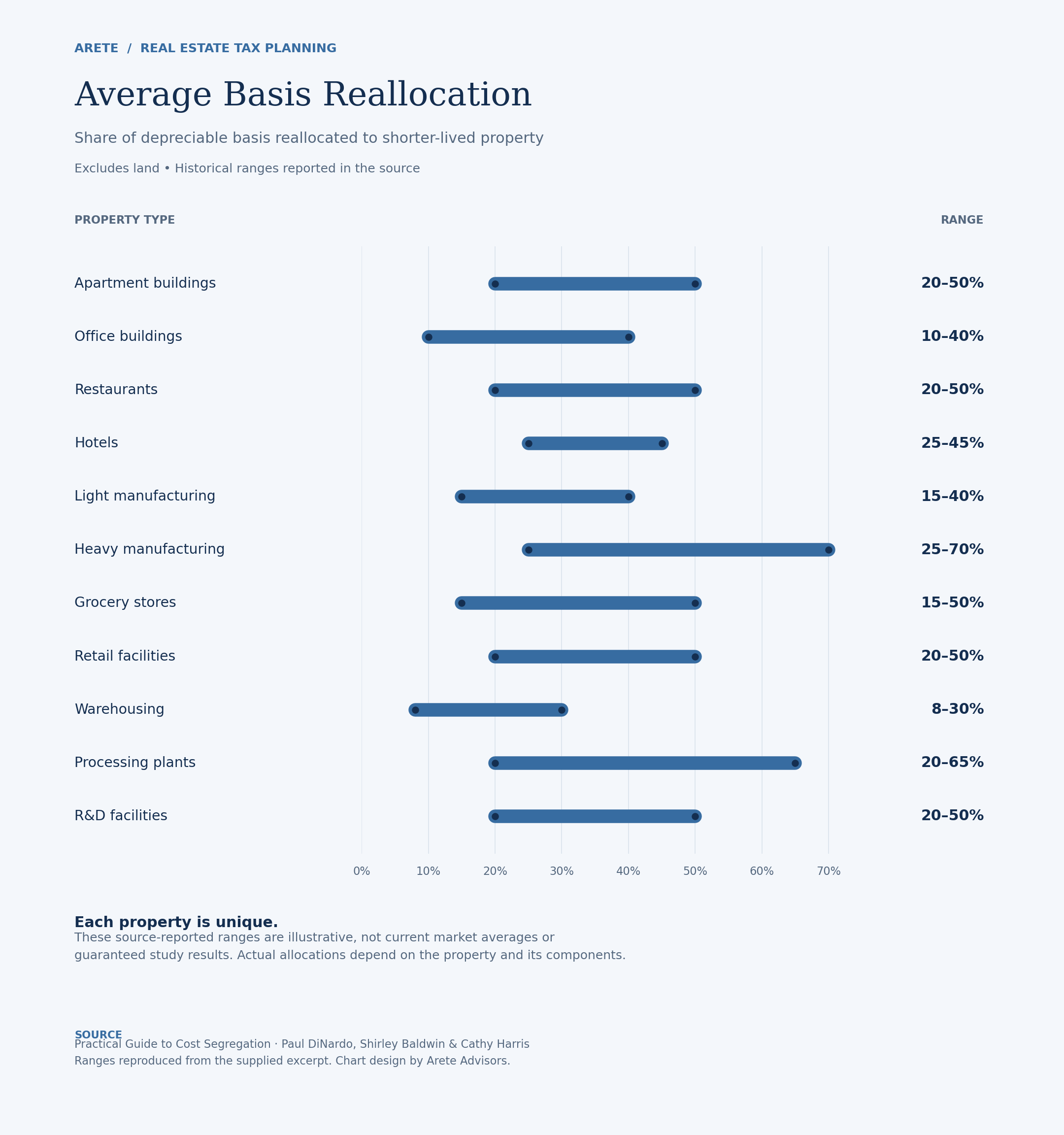
Average Basis Reallocation
The illustration below shows the ranges reported in Practical Guide to Cost Segregation, excluding land. These are historical source-reported ranges. Each property is unique, and characteristics like location, built-out interior space, personal property, and land improvements can all impact the study.
Nonresidential real estate is generally depreciated over 39 years. Due to this extended recovery period, some taxpayers may pass away before receiving the full depreciation benefits. Their heirs generally receive a basis adjustment to fair market value at death, which is often a step-up. A well-planned cost segregation study can accelerate deductions during the owner’s lifetime, potentially increasing cash flow and providing tax deferral.
Hypothetical Example: Including 100% Bonus Depreciation
An investor acquires and places an industrial rental property in service in January 2026 for $4,200,000. Of the purchase price, $420,000 is allocated to nondepreciable land, leaving $3,780,000 of depreciable basis.
Without a cost segregation study: For comparison, assume the entire $3,780,000 depreciable basis is treated as a 39-year building. First-year depreciation would be approximately $92,885.
With a cost segregation study: Assume the study supports allocating 5% of the depreciable basis ($189,000) to 7-year property and 15% ($567,000) to 15-year property. The remaining $3,024,000 stays in the 39-year building category.
| Allocation | Amount |
|---|---|
| Land — not depreciable | $420,000 |
| 7-year property | $189,000 |
| 15-year property | $567,000 |
| 39-year building | $3,024,000 |
| Total purchase price | $4,200,000 |
This example explicitly applies 100% bonus depreciation to the qualifying 7-year and 15-year components. Under the OBBBA, qualifying property acquired and placed in service after January 19, 2025, generally qualifies for 100% bonus depreciation. Assume all eligibility requirements are met and no election out is made.
The investor deducts the full $756,000 allocated to these qualifying components in the first year, plus approximately $74,308 of regular depreciation on the remaining building. Total first-year depreciation is approximately $830,308.
| First-year comparison | Amount |
|---|---|
| Depreciation without the study — illustrative building-only baseline | $92,885 |
| Depreciation with the study and 100% bonus | $830,308 |
| Additional first-year depreciation | $737,423 |
| Federal tax deferral at an assumed 35% marginal rate | $258,098 |
This means approximately $737,423 in additional first-year deductions and $258,098 of federal income tax deferral at an assumed 35% marginal rate, provided all deductions can be used currently. This is primarily a timing benefit, and a future sale may trigger depreciation recapture.
Example assumptions: Calendar-year taxpayer; January 2026 acquisition and placed-in-service dates, with no earlier binding acquisition contract; all reclassified components meet the requirements for 100% bonus depreciation; no election out of bonus depreciation; no Section 179 deduction; and 39-year straight-line depreciation using the mid-month convention for the remaining building. The building calculation uses 11.5 months in year one. Assume full business use and no applicable limits on currently deducting the losses. State taxes, study fees, and a future sale are excluded. Dollar amounts are rounded after calculation.
For a property already in service, bonus depreciation eligibility depends on the original acquisition and placed-in-service dates. Completing a study now does not automatically make an older property eligible for the current 100% rate.
Steps in Completing a Cost Segregation Study
- Analyze property blueprints and project specifications.
- Conduct an on-site property tour.
- Apply applicable IRS regulations and case law.
- Itemize property components that qualify for accelerated depreciation.
- Assign supported costs to these components.
- Identify the appropriate depreciation recovery period for each item.
- Prepare a report with the findings.
The Cost Segregation Final Report
The final report should provide complete documentation, including asset descriptions, photographs, costs, and the engineering procedures used.
Catch-Up Depreciation for Properties Previously Placed in Service
If a property has already been placed in service, a cost segregation study may identify missed depreciation. Eligible taxpayers can generally use an automatic accounting method change to claim catch-up depreciation through Form 3115 and a Section 481(a) adjustment.
A negative Section 481(a) adjustment for missed depreciation is generally deducted in the year of the change, subject to applicable tax limitations. The filing requirements depend on the method previously used and the returns filed, rather than simply whether the property has been in service for more than two years. Generally, using the same impermissible depreciation method on two consecutive filed returns establishes that method.
Important Note
Cost segregation studies do not always lead to immediate tax savings. There are many tax rules that govern how much benefit a taxpayer may receive. In general, passive losses can only offset passive income, subject to exceptions. A study may create a large loss that cannot currently be used.
Future Sale, Depreciation Recapture, and Holding Period
A future sale may trigger depreciation recapture. For certain components identified in a cost segregation study, gain attributable to depreciation, including bonus depreciation, may be taxed as ordinary income under Section 1245, up to the applicable recapture amount.
If you plan to sell in the near future, a cost segregation study may provide limited benefit or may not be worthwhile after considering study fees and potential recapture. The shorter the holding period, the less time you generally have to benefit from the tax deferral.
This strategy may be better suited to long-term holds or properties intended for a qualifying Section 1031 exchange. However, a 1031 exchange does not automatically defer all depreciation recapture. Section 1031 applies only to qualifying real property, and some components identified in the study may not qualify. Even components that qualify as real property for Section 1031 can trigger recapture under separate tax rules. Review the asset allocations and replacement property with your tax advisor before relying on an exchange to continue the deferral.
It is important to complete a thorough analysis of the expected benefit, study fees, holding period, and potential tax consequences on a future sale. Please contact us if you are interested in tax planning or coordination of a cost segregation study at info@arete.cpa.
Sources
Practical Guide to Cost Segregation, Paul DiNardo, Shirley Baldwin, and Cathy Harris (CCH). Basis reallocation ranges and the concept for the hypothetical example are adapted from the supplied excerpts. Example amounts and calculations have been independently revised; they are not figures quoted from the book.
IRS Publication 946, How To Depreciate Property; Instructions for Form 3115; IRS Publication 544, Sales and Other Dispositions of Assets; Instructions for Form 8824.

Disclaimer: This content is for educational purposes only and may not reflect current laws or guidance. Consult your tax advisor before implementing any strategy discussed.